Agency21 June 20265 min read
What is an agentic SDLC? A working definition, and what it takes to run one
An agentic SDLC has AI agents carry whole tasks across the workflow, supervised at review gates. The definition, how it differs from copilot-assisted work, and the three layers it takes to run reliably.
The short answer
An agentic SDLC is a software development lifecycle where AI agents carry whole tasks (planning, editing, testing, opening PRs) across the workflow, with developers supervising at the review gates. It differs from copilot-assisted development by how much work the agents own end to end, not by typing speed. Running it reliably takes durable context, observability, and guardrails; without those, an agentic SDLC is a demo, not a process.
Short version: an agentic SDLC is a software development lifecycle where AI agents carry whole tasks (planning, editing, testing, opening PRs) across the workflow, with developers supervising at the review gates. It isn't a faster copilot. The difference is how much of each stage the agents own end to end, not how fast anyone types. And it only holds up in production when three layers are in place: durable context, observability, and guardrails. Without those, an agentic SDLC is a demo, not a process.
We put that one-paragraph version on its own page too, for when you just want the answer: the agentic SDLC, defined. This post is the longer read behind it.
The definition, clause by clause#
Take the sentence apart, because each clause is doing work.
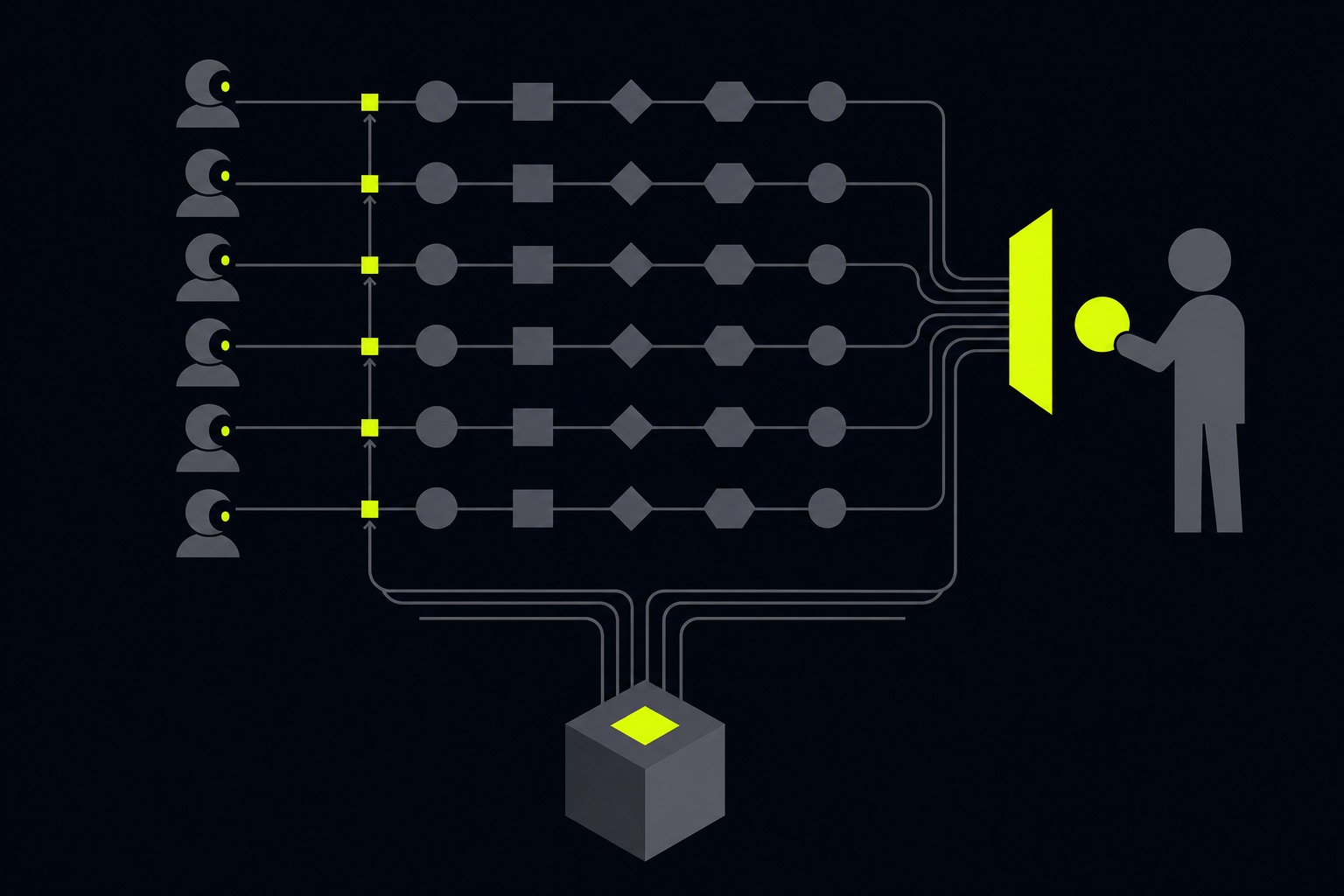
Agents carry whole tasks. A copilot finishes the line you are typing. An agent in an agentic SDLC reads the repo, plans an approach, edits across many files, runs the tests, reads the failures, fixes, and opens a PR. The unit of work is a task, not a keystroke.
Across the workflow. It isn't one heroic step. Agents touch planning, implementation, testing, and the pull request. The lifecycle keeps its familiar shape; what changes is how much of each stage an agent does before a human looks at it.
Supervised at the review gates. The human doesn't leave. The developer sets the goal and the boundaries, then reviews and approves, the same way a senior signs off on a junior's work. Remove that gate and you don't have an agentic SDLC, you have an unsupervised one, which is how this turns risky.
That is the whole definition. The interesting part is what separates a real one from a slideshow.
Agentic SDLC vs copilot-assisted development#
These get used as if they were the same thing. They aren't, and the difference is not speed.
Common questions