16 June 2026
Why AI demos die before production
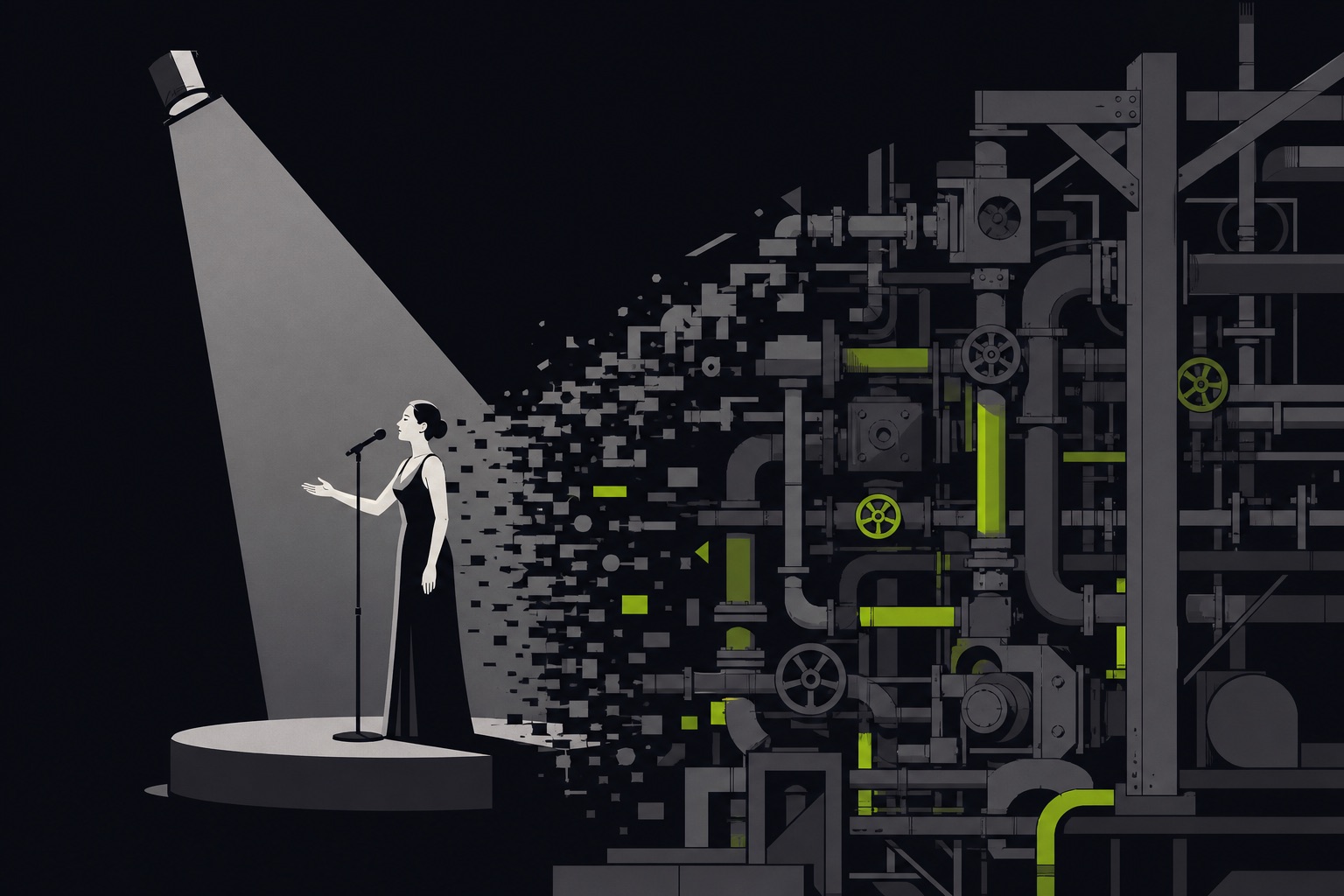
The AI demo always works. Then it meets your real codebase, standards, and scale, and quietly dies. The demo-to-production gap is where most AI initiatives fail.
Short version: the demo works because it's built to. It runs on a clean example, with no legacy, no scale, no compliance, and a human steering every step off-camera. Production has all of those. The demo-to-production gap, not the model, is where most AI initiatives quietly die. What survives the trip isn't a better demo; it's the unglamorous engineering around the model that a demo is designed to hide.
The demo is optimized for the wrong thing
A demo's job is to make the capability legible in two minutes. So it's built on the happy path: a tidy repo, a well-posed task, a result that looks clean. Every demo you've watched, including the good ones, hides the same things, the failures, the cost, the human who reset it three times before recording.
None of that is dishonest. It's just that a demo optimizes for "look what's possible," and production optimizes for "works every time, on our stuff, without babysitting." Those are nearly opposite design goals.
What kills it on the way to prod
The same things, on every team:
- Real context. The demo had a clean example in the window. Your agent has a 2,000-file repo, conflicting docs, and tribal knowledge that lives in nobody's file. Feed it wrong and it's confidently incorrect, expensively.
- Reliability. A demo that works 7 times in 10 is a great demo and a broken production system. The gap from "usually" to "dependably" is most of the actual work.
- Cost at scale. One impressive run is cheap. The same pattern across every dev, every session, every day is a budget line nobody modeled. AI initiatives die in finance review as often as in code review.
- Standards and trust. Your CI, your review culture, your compliance constraints. An agent that ignores them doesn't ship, no matter how good the demo looked.
- The reset button. In the demo, a human silently fixed what went wrong. In production, that human is the cost, and if the system needs constant rescuing, it isn't a system.
Why "just iterate on the prompt" doesn't save it
Teams respond to a dying pilot by tuning prompts. Prompts are the cheapest layer and the least of the problem. What's missing is engineering: a context layer that serves the right information cheaply, orchestration that makes multi-step work reliable, observability that shows what happened and what it cost, and guardrails that respect your standards. Prompt tweaks can't substitute for any of those, and that's usually why the second and third pilots die too.
What actually survives the trip
The teams whose AI reaches production treat it like any other production system: measured, observable, cost-controlled, inside the existing standards, with humans operating it rather than rescuing it. The model is maybe 10% of that. The other 90% is the engineering a demo is built to hide, and it's exactly the part you can't buy as a seat.
How tsukumo thinks about it
We don't do demos. We run agents in production to ship our own software, so we've paid for every failure mode above, and we build client work to survive the trip from day one: production-first, measured, on your standards, with your developers operating it. The proof is that we run what we sell, not that we can record a clean two-minute clip.
If you've watched AI demos dazzle and then die in your own environment, that gap is the work we do. Talk to us about your team.
Common questions