16 June 2026
The copilot-operator gap: why your Claude seats aren't enough
Your team has AI autocomplete, maybe 10% of what coding agents can do. The gap to agents running work in production is an operating problem, not a license problem.
Short version: you bought the seats, your devs have Claude Code, and it autocompletes and answers questions. That's real, and it's maybe 10% of what these models can do. The other 90% is agents running actual work, building, testing, fixing, coordinating, in production. The distance between those two is the copilot-operator gap, and you don't cross it by buying more seats. You cross it by changing how the team operates.
What "copilot" actually gets you
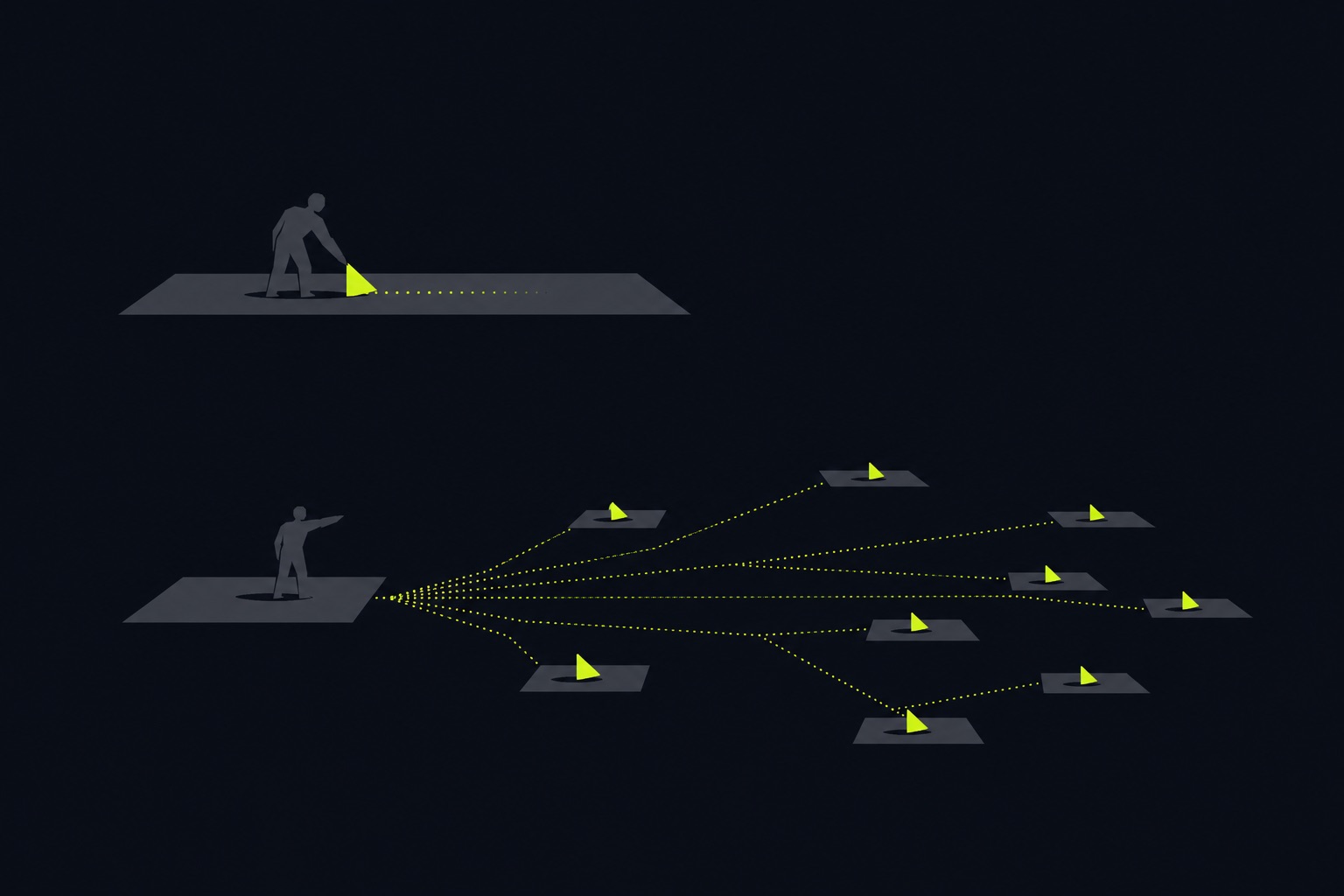
A copilot lives in the editor. It finishes the line you're typing, answers a question about the code in front of you, drafts a function on request. Your dev stays in the driver's seat for every step; the AI is a faster keyboard and a good rubber duck.
That's genuinely useful. It's also bounded: the AI only acts when prompted, on the thing you're looking at, one suggestion at a time. The dev's hands are still on every part of the work. You get a speedup, not a step change.
What "operator" looks like
An operator runs agents that do whole units of work. The dev sets the goal and the guardrails; the agent plans, edits across many files, runs the tests, reads the failures, fixes, and reports back. The dev reviews and steers, but isn't typing every line or watching every step.
Now scale that to a fleet: several agents working in parallel on different parts of the codebase, coordinating, while the dev operates them like a senior engineer operates a team. That's where the order-of-magnitude change comes from. It's also where it stops being a tool you install and starts being a way of working you have to build.
Why seats don't close the gap
Because the gap isn't a feature you're missing. It's everything around the model:
- Context. An agent doing real work needs the right project knowledge, cheaply, on demand, not a copilot guessing from the open file. Get this wrong and agents are expensive and confidently incorrect.
- Orchestration. One agent is a script. A fleet is a coordination problem: who does what, in what order, without colliding. Seats don't give you this.
- Observability. You can't run agents in production on faith. You need to see what they did, what it cost, and where they went wrong. Most teams have none of this.
- The team's habits. Devs trained on copilot reach for it like autocomplete. Operating a fleet is a different skill, and it has to be taught, not licensed.
A license gives you model access. None of the four above comes in the box.
Why teams stall here
Most teams aren't stalled because they're behind. They're stalled because the jump looks like "use the same tool more" and it isn't. They try harder with copilot, hit the ceiling of what prompting-in-the-editor can do, and conclude the hype was overblown. The hype was wrong about the ease, not the ceiling. The ceiling is real and most teams never reach it.
There's also a people problem that licenses make worse: devs who suspect "agent" means "replace me" won't push the tool to its limit. Crossing the gap depends on the opposite framing, your developers become the operators, and the gains are theirs.
How tsukumo closes it
This gap is our whole reason to exist. We're a dev studio that runs agent fleets in production to ship our own products, and we transition client teams from copilot to operator on their own stack and standards. We bring the context, orchestration, and observability layers we run ourselves, and we train your developers to operate, not to be replaced.
If your team has the seats and can feel there's a bigger capability they haven't reached, that's exactly the gap we cross. Talk to us about your team.
Common questions