What agentic product development actually is (and how it beats a dev shop)
A dev shop hands you a codebase and an invoice. An agentic studio builds your product the way you'll eventually run it: agent fleets in production, your standards, your repo, no lock-in. Here's the difference.
tsukumo
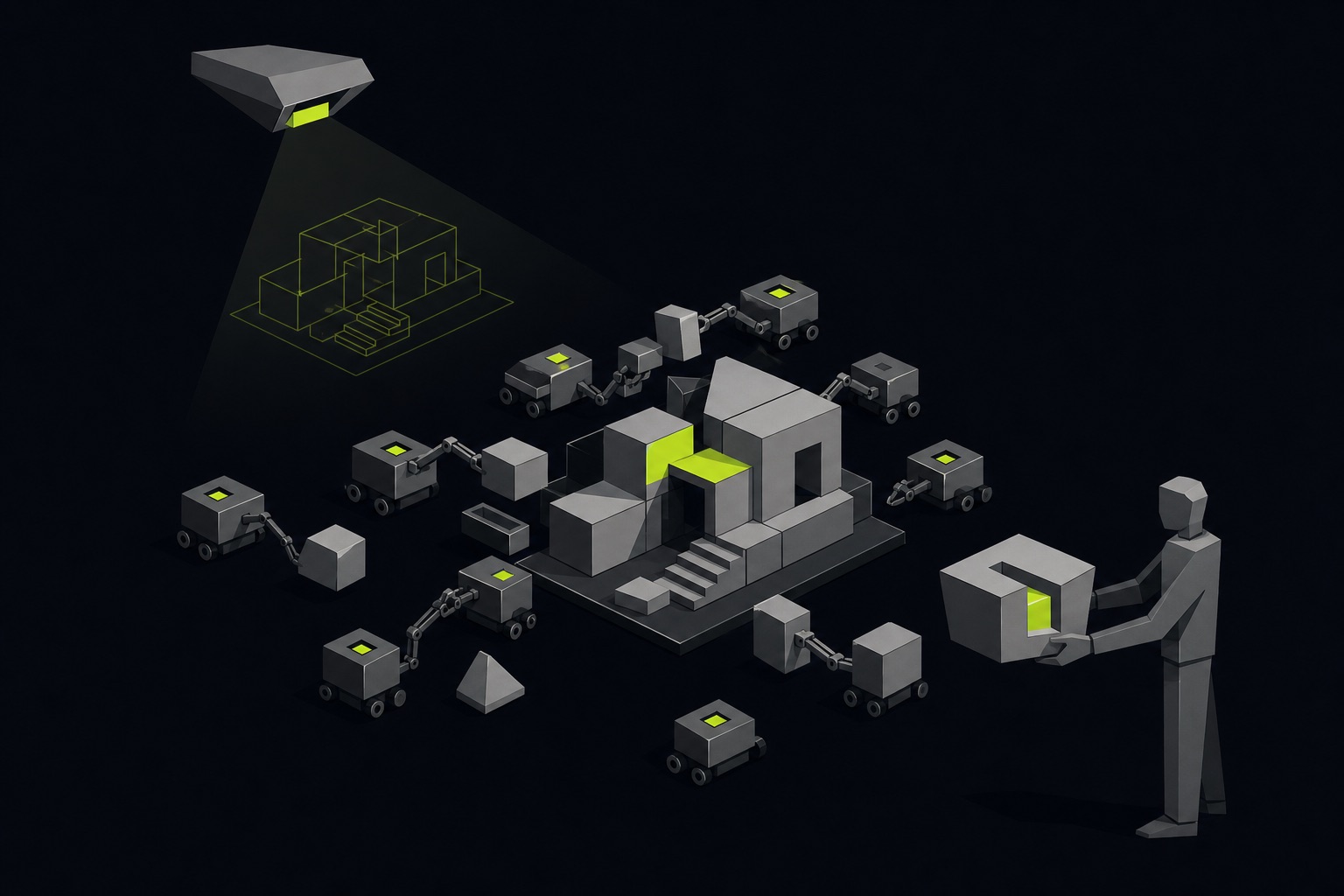
Short version: a normal dev shop hands you a codebase and an invoice, and walks away. Agentic product development is different in one specific way: a studio builds your product using the same fleets of AI agents it would eventually hand your team, in production, against your standards. You get the shipped product, you own the code and the repo, and you keep a working demonstration of how the agents were operated. You're not buying cheaper development. You're buying a product built the way you'll run it.
Most software is still built by humans typing every line, with AI as autocomplete on the side. Agentic development moves the developer up a level: they scope work, set guardrails, and review, while fleets of agents do the building, testing, and coordinating. We run our own products this way. The open suite we ship for ourselves (WRAI.TH for orchestration, trovex for context, yoru for observability) is the proof that it's how we work, not a pitch.
The shift matters because of pace and reach. A small team operating agents can take on the scope that used to need a much bigger one, without dropping to demo-grade quality. That's the studio bet: real production software, shipped faster, because the operating model around the agents is the product we've spent the most time on.
How is it different from a dev shop or outsourcing?#
Because of what's left after the work is done.
A dev shop optimizes for delivering your spec for the agreed hours. When it's over, you have a codebase and a relationship you have to keep paying to extend. Nothing about how it was built transfers to you. Outsourcing is the same trade with more distance.
An agentic studio builds with the operating model visible the whole time. The agents run on your repo, your CI, your review culture, so by the end you've watched the way of working on your own product. The product is the deliverable. The capability is the byproduct, and the byproduct is the part a dev shop can't give you. This is the same reason the build-vs-buy decision usually isn't a clean either-or: done right, buy is a path to build.
What's left after the work is done
Criterion
Dev shop / outsourcing
Agentic studio
Who writes the code
Their humans, by the hour
Agent fleets you supervise
Runs against your CI and review culture
No, their sandbox
Yes, from day one
What you own at the end
A codebase
The codebase and the repo
What transfers to your team
Nothing
The operating model, watched on your own product
To extend it later
Keep paying the shop
Keep going without us
Prefer this built rather than figured out? That's the studio: we ship it on the same fleets we'd hand your team.
No, and that's a deliberate design choice, not a reassurance.
You own the code and the repo. There's no platform to rent, no runtime that holds your product hostage, nothing that stops you continuing without us. We'd rather you could leave, because a studio that traps clients is selling dependency, and dependency is the opposite of what an operating model is for. The test of the engagement is whether your team could pick up where we left off. The answer should be yes.
The POC-that-dies-after-the-demo is the default failure mode of AI work, and it's exactly what agentic development is built to avoid. We ship to production against your real standards from the start, not a sandbox that looks impressive and falls over on the first real input. We've written at length on why AI demos die before production; the short version is that production needs engineering the demo skips, and we do that engineering because we run agents in our own production every day.
"Agentic" doesn't lower the quality bar. It's how we hold the bar while moving faster.
Two things, and the second is the one that compounds.
The product, shipped to production on your stack, owned by you. That's the obvious one.
A working demonstration of the operating model. By the time we're done, agents have been running real work on your codebase, and you've seen what it takes to operate them well. So if you later want your own developers working this way, you're not starting from a slide deck. You're starting from a system that already ran on your own product. That's the bridge to the copilot-operator gap, crossed on a real engagement instead of in the abstract.
Use the studio when you want the product built and you don't have the team, or the time, to build it agentically yourself yet. Use consulting when you have the team and want them operating agents on your own work. They're the same capability from two directions, and the line between them is thinner than it looks. Plenty of studio clients move to consulting once they've watched the operating model run on their own product and want it in-house.
We build this for ourselves and for clients: agentic-development for Clareo Systems, an agent-first marketing platform for Compagnie Immobilière du Léman. The work is the real record, qualitative outcomes and all.
If you have something you want built, and you'd rather it came with the way of working baked in than as a black box, that's the studio. Tell us what you want built.
We'll scope the product and show you the operating model running on your own repo. You leave owning both.
It's building software with fleets of AI agents operating in production, supervised by developers, instead of humans typing every line. A studio that works this way ships the product and leaves you a repeatable operating model you can run yourself, on your own code and standards.
How is an agentic studio different from a normal dev shop?
A dev shop sells hours and hands back a codebase. An agentic studio builds with the operating model running, so the byproduct is a capability: you've watched agents do real work on your product, against your CI and review culture, and you can adopt that way of working when you want it. You're not buying cheaper development. You're buying a product built the way you'll run it.
Do we own what you build?
Yes. Your code, your repo, no platform to rent and nothing that leaves you locked to us. We're builders, not a vendor you can't leave. The point is that you could keep going without us.
Is this just a POC that dies after the demo?
No. We ship to production against your real standards from the start, the same way we run our own software. A demo that can't survive your CI was never the goal, and "agentic" doesn't lower the bar, it's how we hold it at speed.
Should we use the studio or the consulting door?
Studio if you want us to build the product. Consulting if you want your own team running agents on your work. They're the same capability from two directions, and studio clients often move to consulting later because they've already seen the operating model run on their own product.