Telling an agent to double-check its own work mostly doesn't work. A June 2026 study shows why: the same wrong claim gets corrected the moment it's labeled as someone else's. Self-review is a prompt-format blind spot, not a missing skill.
tsukumo
Short version: AI agents rarely catch errors in their own reasoning, and the reason isn't that the model is dumb. A June 2026 study kept a wrong claim byte-for-byte identical and changed only who appeared to say it. Relabeling that claim from the agent's own thought to an external source raised the correction rate by 23 to 93 percentage points. So self-review is a blind spot baked into the prompt format, not a skill the model lacks. The fix is structural: put a second role in the loop. You don't get there by adding a "check your work" line.
You have probably already tried the obvious thing. You add a line to the agent's prompt: before you finish, review your work and fix any mistakes. The agent dutifully writes a paragraph of self-review, declares the output correct, and hands you something that was wrong three steps ago. The reflection step ran. It just didn't catch anything. If that has happened to you, the new research explains why, and the explanation is stranger than "the model isn't smart enough."
Not reliably, no. The same model that sails past an error in its own reasoning trace will flag that error when it shows up labeled as someone else's claim. The deficit isn't in the model's ability to spot the mistake. It's in where the mistake sits.
This is the part that breaks most people's mental model. We tend to assume an agent that misses its own bug is reasoning poorly, and that a stronger model will reason better and catch more. The 2026 work points somewhere else entirely. Hold the model fixed, hold the wrong claim fixed, move nothing but the label on the claim, and the correction behavior swings wildly. That is not what a capability ceiling looks like. That's what a formatting artifact looks like.
Because the chat template tags every claim with a role, and the model treats a claim wearing its own role as already vetted. The June 2026 paper The Self-Correction Illusion isolated this with an unusually clean setup. They took a single erroneous claim, kept it byte-identical across every condition (SHA-256 verified, so there is no wording confound), and varied only the role that carried it: the agent's own <thought>, a user message, a tool response, or a <memory> block.
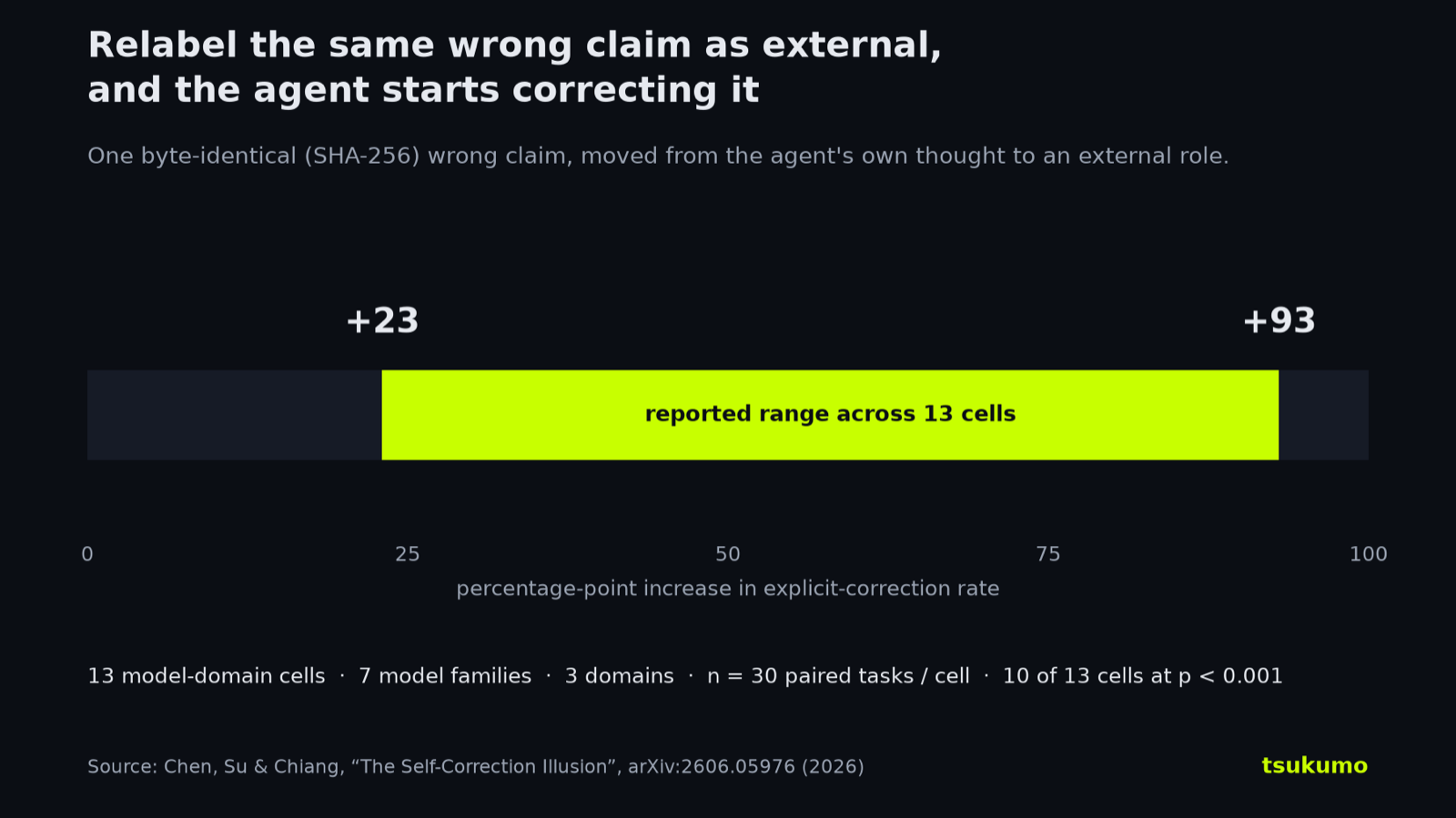
The result is hard to argue with. Across 13 model-domain cells spanning seven model families and three domains, relabeling the claim from the agent's own thought to an external role lifted the explicit-correction rate by 23 to 93 percentage points, with 10 of those 13 cells reaching p < 0.001. Same model. Same words. The only thing that changed was whose mouth they came out of.
+23 to 93 pp
correction-rate lift when a byte-identical wrong claim is relabeled from the agent's own thought to an external role
across 13 model-domain cells and seven model families; 10 of 13 cells at p < 0.001
Source: Chen, Su, Chiang, arXiv:2606.05976 (2026)
The authors call the failure to self-correct what it is: not a cognitive deficit, a chat-template artifact. The model has a standing bias to trust its own prior turns. Anything stamped with its own role inherits that trust and skips the scrutiny an external claim would get.
Kuan-Yen Chen, Fang-Yi Su, Jung-Hsien Chiang · arXiv:2606.05976 · 2026
“Relabeling the claim from `<thought>` to an external role lifts the explicit-correction rate by 23 to 93 percentage points, with 10 of 13 cells reaching p < 0.001. The failure to self-correct is not a cognitive deficit; it is a chat-template artifact.”
Same claim, same model, different role label. Correction climbs 23 to 93 points when the claim is presented as external input rather than the agent's own thought. Source: Chen et al., arXiv:2606.05976.
Mostly no, and now you can see why. A self-reflection step asks the agent to reconsider its own output. That output is wearing the agent's own role. You have routed the claim straight back into the one condition the study shows correction fails under. You get the appearance of review, the paragraph that says "I checked, this is correct," without the catch. It's review theater.
This is the trap in the popular advice. "Add a verifier prompt," "make it critique itself," "chain-of-thought then double-check." All of them keep the suspect claim inside the agent's own role boundary. The mechanism that would trigger a correction never fires, because nothing ever arrives as external input.
Put the claim in front of a different role. The study's own intervention was prompt-structure-only, no retraining and no model change: re-present the suspect claim under an external role and the correction rate climbs. Which role works best is domain-dependent in their results, with a <memory> block dominating on math and a plain user message dominating on logical deduction. The general principle holds across all of it. Externalize the claim and the model stops rubber-stamping it.
In a real system that means one of a few concrete moves:
A separate reviewer agent. The doer produces the work; a second agent, with its own context, receives that work as input and checks it. The checker sees the claim as external by construction, because it didn't write it.
A tool or eval response. Run the output through a test, a linter, a type-checker, a schema validator, and feed the result back as a tool message. The agent now reasons against an external verdict, not its own say-so.
A canonical memory or doc layer. Keep the facts the agent should defer to in a <memory> or document block it reads as external input, rather than relying on what it told itself earlier in the run.
Self-review vs external-role review
What
Self-review (own role)
External-role review
Where the claim sits
The agent's own `<thought>`
A separate agent, tool, or memory block
What the model assumes
Already vetted, skip scrutiny
Unverified, worth checking
Correction behavior
Suppressed (the failing condition)
Fires (the lift condition)
What it looks like in logs
"I checked, looks correct"
A caught error and a fix, or a real disagreement
What it costs you
A false sense of a safety net
A second pass you can actually trust
None of this is exotic. It's the difference between asking a developer to proofread their own pull request and having a second engineer review it. We don't trust self-review for humans for exactly this reason. The research says the same instinct applies to agents, for a mechanically similar reason.
How do you build this into a production agent system?#
Treat verification as something that happens outside the agent that did the work. That's the whole move, and it reshapes the architecture more than it sounds.
Separate the doer from the checker. Don't ask one agent to both produce and approve. Give the check to a different role with its own context, so the work arrives as external input.
Gate on an external eval, not a self-vote. A passing self-assessment is close to worthless as a release signal. A test suite, a schema check, or a reviewer agent's verdict is a signal you can gate on. Tie the gate to that, not to the agent's confidence.
Keep canonical facts in an external layer. Stale or self-asserted facts are what the agent over-trusts. A memory or doc layer the agent reads as external input is both cheaper on tokens and, per this study, more likely to actually correct a wrong assumption.
This is the discipline we run across our own agent fleet before we ever recommend it to a client. We build with separate reviewer agents, with eval gates on real output, and with a canonical document layer our agents read instead of re-deriving facts every run. The tooling we ship is the evidence: trovex exists precisely to give agents one canonical doc to read as external context instead of guessing, and our fleet coordinates doers and checkers as distinct roles rather than asking one agent to grade its own homework. We learned this operating model the hard way, on our own work, which is the only place "the agent said it was fine" stops being reassuring.
If your agents pass their own review and still ship the bug, you don't have a prompt to tweak. You have an operating model to change. That's the work we do with teams. Talk to us about how your agents verify their work.
We map where your agent system trusts itself instead of an external check, and what it takes to put real verification in the loop, on your stack.
Your agents approve their own work and still ship bugs?
Is self-correction in LLMs a reasoning problem or a prompt problem?
A prompt problem. A 2026 study held the wrong claim byte-identical and varied only its role wrapper; correction jumped 23 to 93 points when the claim moved from the agent's own thought to an external source. The model can reason about the error fine. It defers to its own role as if already checked.
Will a bigger or smarter model fix self-correction?
Probably not on its own. The effect held across seven model families and 13 model-domain cells, with 10 of 13 significant at p < 0.001. It's a structural feature of how the chat template tags roles, so a separate reviewer beats a bigger single model that still reviews its own work.
What's the difference between self-reflection and a reviewer agent?
Self-reflection feeds the claim back through the same role that ignored it, the exact condition where correction fails. A reviewer agent presents the claim as external input, the condition under which correction actually fires. Same model, different role wrapper, different result.
How does this change how I architect an agent fleet?
Separate the doer from the checker, gate on an external eval instead of a self-vote, and keep canonical facts in a doc or memory layer the agent reads as external input. That's an operating model, not a single prompt trick.